Welcome to the first post in our ongoing Ambient Insights blog series. We plan to share new posts monthly or every other week, depending on the topics and updates we have to share. Through this series, we will explore our research, technology, collaborations, and broader efforts to make neurological assessment more objective, accessible, and useful.
A concussion can be difficult to measure.
Someone can experience a change in how they move, react, balance, or process information without there being an obvious physical sign. Symptoms can also vary from person to person, making assessment a challenging combination of clinical observation, physical testing, and self-reported symptoms.
That challenge is where our work began.
At Ambient Insights, we are developing technology that explores whether everyday devices can help capture objective information about how a person performs during a neurological assessment. Our first product, FlightPath, grew out of research and collaboration between engineers and healthcare professionals at the University of Illinois and OSF HealthCare. That research continues today through collaborations with universities, healthcare organizations, researchers, and sports programs.
From a Research Question to FlightPath
The original question behind FlightPath was relatively simple:
Can we use technology to measure things about human movement and interaction that may be difficult to capture through traditional assessments?
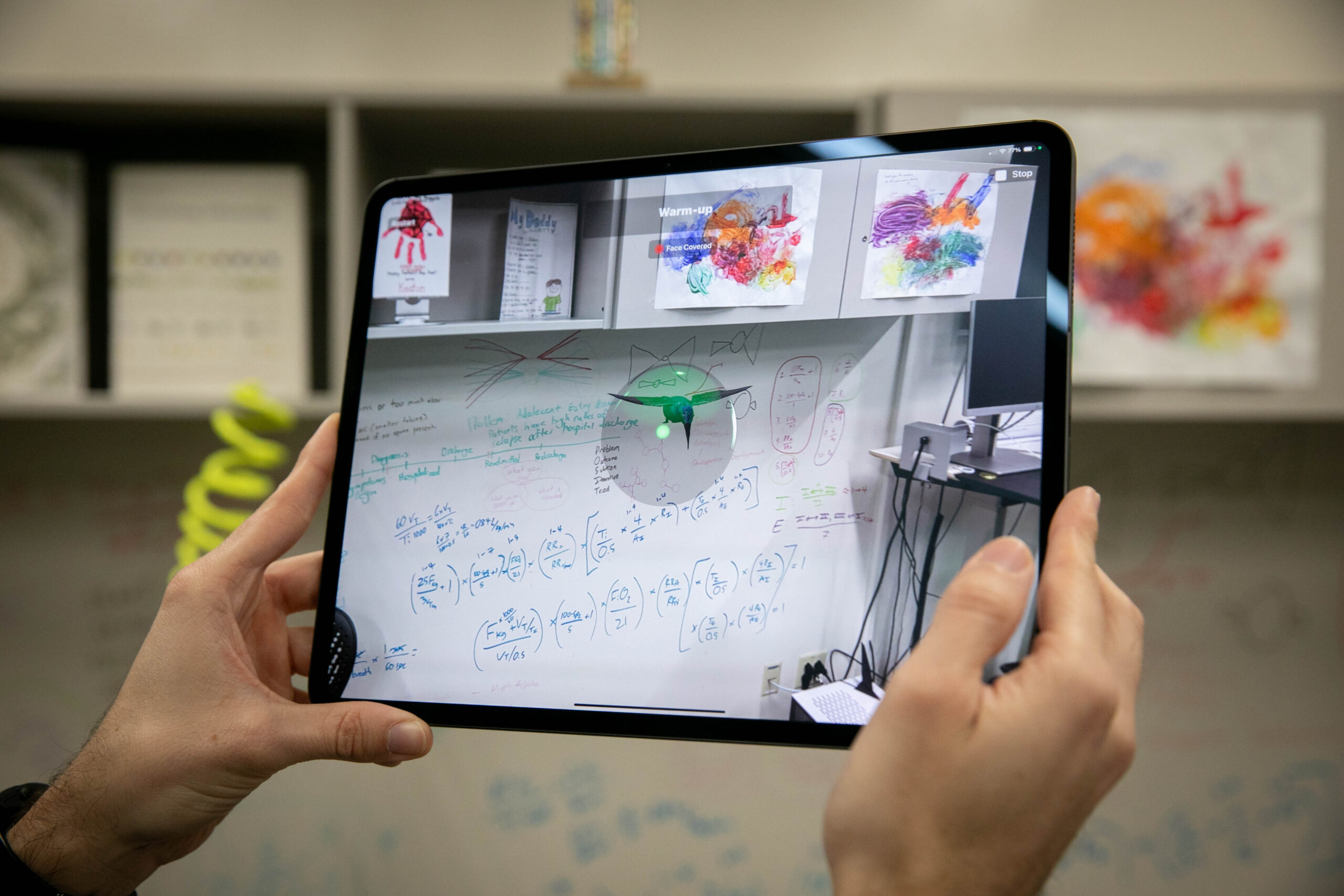
To explore that question, the research team developed a mixed-reality experience built around a virtual hummingbird.
During a FlightPath assessment, the user interacts with the hummingbird through an Apple device. The hummingbird moves through the user’s environment, and the user attempts to follow it. What looks relatively simple from the outside creates a dynamic task involving movement, visual attention, coordination, reaction, and spatial interaction.
Behind that interaction, the device’s sensors are collecting information about what is happening during the test.
FlightPath uses technologies including LiDAR, motion and spatial sensing, augmented and mixed reality, and machine learning to turn those interactions into data that can be studied as potential digital biomarkers.
The important part is not simply that the test uses an Apple device or mixed reality. It is that these technologies give researchers a way to observe human performance in a much more detailed way than simply asking someone how they feel.
Why Use an Apple Device?
One of the things we find exciting about FlightPath is that it does not require a specialized laboratory setup.
Modern Apple devices can contain sophisticated cameras and depth sensors in a package that is portable and familiar to many people. That creates an interesting opportunity for health research: can technology that already exists in a consumer device be used to collect meaningful information about human performance?
For FlightPath, LiDAR and other device sensors allow us to understand aspects of the user’s position, movement, and interaction with the virtual target. Mixed reality then gives us a structured environment in which to study those behaviors.
Machine learning provides another layer. Rather than looking at one measurement in isolation, our research focuses on patterns across the large amount of information generated during an assessment.
This is where the idea of a digital biomarker becomes important.
A digital biomarker is, broadly speaking, a measurable characteristic captured through digital technology that can provide information about a person’s health or function. Our work is focused on determining whether patterns captured during FlightPath can provide useful information about neurocognitive impairment and concussion.
We are still doing the research needed to answer that question.
And that distinction matters.
Research Comes Before Claims
FlightPath is not intended to replace a healthcare professional or serve as a standalone medical decision-maker.
Our current work is focused on validation: collecting data, comparing FlightPath measurements with established assessments, studying how the technology performs across different populations, and understanding where it can provide useful information.
FlightPath has already been studied with collegiate athletes. Research has compared FlightPath data with existing concussion assessment methods as researchers work to understand the relationship between the data generated by the application and clinical findings.
That research process is a major part of what we are building at Ambient Insights.
We believe health technology should be developed alongside the people who understand the problem firsthand. That means working with clinicians, researchers, engineers, athletic programs, and healthcare organizations rather than developing a technology in isolation.
From FlightPath to a Larger Platform
FlightPath is the first part of what we are building.
Our broader goal at Ambient Insights is to explore how technology can make neurological assessment more objective, accessible, and useful.
That includes the technology used to collect information, but it also includes what happens after the assessment.
NeuroDNA, for example, represents the clinician-facing side of this work. The idea is to take complex information generated during an assessment and organize it into information that can be interpreted and used by healthcare professionals and researchers.
The research that led to FlightPath and NeuroDNA was itself built through collaboration. The University of Illinois and OSF HealthCare have worked together through the Jump ARCHES research model, which brings clinicians and engineers together to work on healthcare problems. FlightPath and NeuroDNA were among the projects developed through that collaboration.
That collaborative approach continues to influence how we think about Ambient Insights.
Where We Are Going
There is still a lot to learn.
Our next steps are centered around continued research, clinical validation, improving the technology, and working with additional partners who can help us understand where FlightPath is most useful.
We are particularly interested in working with researchers and healthcare organizations that want to explore objective measures of neurological function and how digital biomarkers might complement existing approaches.
For us, the goal is not to add technology for the sake of technology.
It is to ask whether the technology can provide information that is actually useful.
That is why we started with a simple idea: use the devices and sensors around us to better understand how people interact with the world.
FlightPath is our first attempt at turning that idea into something practical.
There is still research to do, questions to answer, and validation ahead. But that is also what makes the work exciting.
We are continuing to build, test, learn, and collaborate — with the goal of making neurological assessment more measurable and, ultimately, more useful for the people who rely on it.
As this blog continues, we will share updates on our research, product development, partnerships, and the questions guiding our work. If you are interested in collaborating with Ambient Insights, exploring research opportunities, or simply learning more about FlightPath and our broader vision, we would be glad to hear from you. Please reach out to start a conversation.


Leave a Reply